If you’re asking yourself, “My PSA is 56 — should I worry?”, it’s completely normal to feel scared, confused, or overwhelmed. Many men immediately think: “Does this mean I have cancer?”
The truth is: a PSA level of 56 is high, but it does not automatically mean cancer — and there are clear, logical next steps that can help you understand what’s really going on before jumping into invasive procedures.
In this article, you’ll learn:
- What a PSA level of 56 really means
- How dangerous PSA levels are classified
- Why PSA can spike even without cancer
- What doctors usually recommend next
- And what you can do right now to support prostate health
Let’s walk through this calmly, clearly, and without panic.
Why Do Many Men Think: “My PSA Is 56 — Should I Worry?”
When men see a PSA result as high as 56, the first reaction is often fear — and that reaction makes sense. For decades, PSA testing has been closely associated with prostate cancer screening, so a high number naturally triggers alarm.
But PSA is not a cancer test — it’s a prostate activity marker.
Many men aren’t told that:
- Inflammation alone can spike PSA dramatically
- Benign prostate enlargement can raise PSA into double digits
- Temporary factors like infection or irritation can cause sudden jumps
- Even very high PSA levels don’t always mean aggressive disease
That’s why so many men Google “My PSA is 56 — should I worry?” — not because they’ve been diagnosed with anything, but because they’re stuck in uncertainty. The real issue isn’t the number itself. It’s not knowing what the number actually means — and what steps come next.
Once men understand how PSA works, how doctors interpret results, and how modern imaging now guides diagnosis before biopsy, fear usually gives way to clarity — and control.
And that’s exactly what this article is designed to give you.
What Is PSA and Why Do Levels Rise?
PSA (prostate-specific antigen) is a protein made by the prostate gland and released into the blood. A PSA blood test helps doctors assess prostate activity — but PSA alone does not diagnose cancer.
Many things can raise PSA levels, including:
- Prostate inflammation (prostatitis)
- Enlarged prostate (BPH)
- Urinary infections
- Recent ejaculation
- Cycling or pressure on the prostate
- Recent prostate exams or procedures
So while high PSA levels deserve attention, they don’t automatically mean prostate cancer.
Is a PSA Level of 56 Dangerous?
Let’s put PSA values into perspective.
Doctors generally classify PSA levels as:
| PSA Level | Meaning |
|---|---|
| Under 4 | Usually considered normal |
| 4–10 | Mildly elevated |
| 11–20 | Moderately elevated |
| 21+ | High |
| 50+ | Very high — requires prompt evaluation |
A PSA of 56 falls into the very high PSA level category. Statistically, higher PSA levels increase the likelihood of prostate cancer — but not all men with PSA over 50 have cancer, and not all prostate cancers are aggressive.
What matters just as much as the number itself:
- How fast PSA is rising (PSA velocity)
- Your age
- Prostate size
- Symptoms
- Whether infection or inflammation is present
- MRI imaging results
So yes — PSA 56 should not be ignored, but it should also not trigger panic. It’s a signal to investigate carefully and intelligently.
If My PSA Is 56 — Should I Worry Right Now?
Short answer: You should take it seriously, but not catastrophize.
Many men with PSA in the 40–70 range end up discovering:
- Inflammation rather than cancer
- Benign enlargement
- Early-stage prostate cancer that is highly treatable
What matters most is what happens next, not just the number itself.
What Doctors Usually Recommend After a PSA of 56
Instead of rushing straight into biopsy, most urologists now follow a smarter sequence:
1️⃣ Repeat the PSA test
Transient PSA spikes happen. A repeat test helps confirm whether the elevation is persistent.
2️⃣ Check for infection or inflammation
Urine tests and symptom evaluation help rule out prostatitis or urinary tract infections — both of which can drastically raise PSA.
3️⃣ Prostate MRI
Multiparametric MRI is now standard before biopsy. It helps:
- Identify suspicious areas
- Reduce unnecessary biopsies
- Improve cancer detection accuracy
4️⃣ Biopsy (if imaging suggests risk)
Only when MRI or PSA trends indicate concern does biopsy usually follow.
This staged approach protects men from unnecessary procedures while ensuring serious cases are caught early.
What Is Considered a Dangerous PSA Level?
Many men ask: “What PSA level is considered dangerous?”
There’s no single cutoff, but risk generally increases at:
- PSA above 10 → higher cancer probability
- PSA above 20 → significantly elevated risk
- PSA above 50 → strong signal requiring urgent evaluation
However, danger depends on context, not just numbers. Some men with PSA of 12 have aggressive cancer. Others with PSA of 60 have inflammation and no cancer at all. That’s why modern medicine looks beyond PSA alone.
PSA Levels by Age — Does Age Matter?
Yes. PSA naturally rises with age because the prostate grows over time.
Typical PSA ranges by age:
| Age | Normal PSA Range |
|---|---|
| 40–49 | 0–2.5 |
| 50–59 | 0–3.5 |
| 60–69 | 0–4.5 |
| 70+ | 0–6.5 |
But even within these ranges:
- Cancer can exist at low PSA levels
- Benign causes can exist at high PSA levels
So while PSA levels by age provide context, they do not replace proper evaluation.
Can PSA Levels Be High Without Cancer?
Yes — and this is one of the most misunderstood parts of PSA testing.
Common non-cancer causes of elevated PSA include:
- Prostatitis (inflammation)
- Enlarged prostate (BPH)
- Urinary infections
- Recent ejaculation
- Recent prostate exams
- Heavy cycling
In some men, treating inflammation alone causes PSA levels to drop dramatically within weeks.
How Fast PSA Is Rising Matters More Than One Test
Doctors often look at:
- PSA velocity → How quickly PSA increases over time
- PSA density → PSA relative to prostate size
- Free PSA percentage → Helps distinguish cancer vs benign causes
A PSA of 56 that jumped from 5 in three months is very different from a PSA of 56 that rose gradually over several years.
What If My PSA Is 56 — What Should I Do Right Now?
Here’s the smart, calm action plan:
✔️ Repeat the PSA test
✔️ Rule out infection or inflammation
✔️ Get a prostate MRI
✔️ Discuss biopsy only if imaging supports it
✔️ Begin supporting prostate health immediately
And yes — many men take steps to reduce inflammation and support prostate health naturally while working through testing.
👉 If you want to see what many men are using before medications or procedures — and why this unusual approach is getting attention — you can learn more here.
(And don’t worry — we’ll keep explaining everything below.)
Can PSA Levels Be Lowered Naturally?
While medical evaluation is essential, many men also look for ways to support prostate health at home — which can influence PSA levels —, especially when they want to avoid rushing into invasive procedures.
Lifestyle changes are often the first step. They can:
- Improve gut health
- Support urinary flow
- Help manage inflammation
And despite how overwhelming habit changes can feel at first, there are simple and effective natural ways to lower PSA levels many men explore alongside medical monitoring — especially before biopsies or surgery.
PSA Levels and Prostate Cancer — What Are the Odds?
Risk increases with PSA, but outcomes vary:
| PSA Range | Approximate Cancer Risk |
|---|---|
| 4–10 | ~25% |
| 10–20 | ~40–50% |
| 20–50 | ~60–70% |
| 50+ | Higher — but not guaranteed |
Even when cancer is present:
- Many cases are slow-growing
- Many do not require immediate treatment
- Survival rates for early-stage prostate cancer are excellent
The goal is smart diagnosis, not rushed treatment.
❓ FAQ – PSA Levels
What is a normal PSA level for men?
Normal PSA varies by age, but generally under 4 is considered non-elevated. However, PSA interpretation always depends on context.
What PSA level is considered high?
Above 10 is considered high. Above 20 is very elevated. Above 50 requires prompt evaluation, but does not automatically mean cancer.
Does PSA increase with age?
Yes. PSA levels naturally rise as the prostate enlarges with age.
Can PSA go down on its own?
Yes. PSA often drops after treating inflammation, infection, or temporary prostate irritation.
How high can PSA levels go?
PSA can rise into the hundreds or even thousands in advanced disease — but most elevations are far lower and often reversible.
👉 Final Thoughts: My PSA Is 56 — Should I Worry?
PSA 56 is serious, but it’s not a sentence. If your PSA is 56, your body is asking for attention — not panic.
Modern prostate care focuses on:
✔️ Imaging before biopsy
✔️ Understanding inflammation
✔️ Monitoring trends over time
✔️ Avoiding unnecessary procedures
✔️ Preserving quality of life
You are not behind. You are not out of options. And you are not alone.
With the right information, testing, and support, most men navigate this safely — and many avoid invasive treatments entirely.
You may also find this helpful:
👉 What Is a Dangerous PSA Level? What the Numbers Really Mean — and When You Should Worry
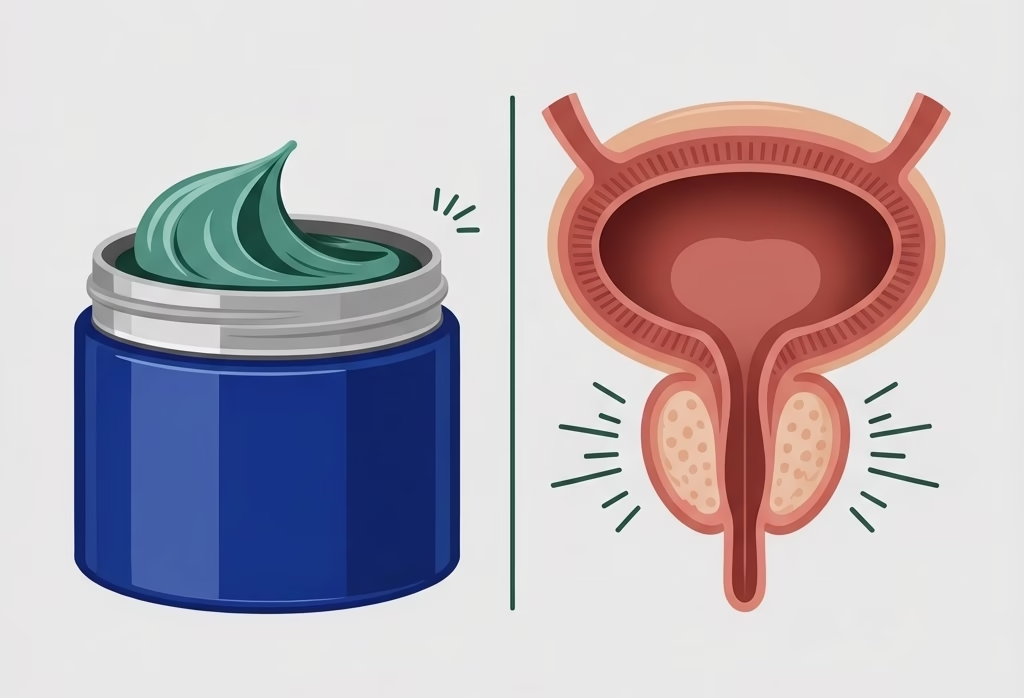
👉 Vicks VapoRub for Prostate: What You Should Know (And Why So Many Men Are Trying It)
👉 The 15-Second Prostate Method Explained — And Why Men Are Giving It a Try
Disclaimer:
The information provided in this article is for educational purposes only and is not a substitute for professional medical advice, diagnosis, or treatment. While natural remedies and lifestyle changes may help relieve symptoms of an enlarged prostate, it’s important to consult with a healthcare provider—especially if symptoms persist or worsen. Early diagnosis and proper medical guidance are essential for long-term prostate health and overall well-being.